
The Age of Self-Written Fates
Entrant Company
Cultural Affairs Bureau of Hsinchu City
Category
Conceptual Design - Exhibition & Events
Client's Name
Country / Region
Taiwan
The exhibition “The Age of Self-Written Fates” reexamines the cultural, material, and philosophical significance of language in an era shaped by rapid digital reproduction and artificial intelligence. Centered on the layered meanings of “好字為之/好自為之” (to write well, to act well), the exhibition invites the public to reconsider the role of words as both ethical action and cultural expression.
Language has long served as a fundamental medium for civilization, enabling the transmission of knowledge, memory, and identity. Yet in a time when information is produced, duplicated, and disseminated at unprecedented speed, the ability to discern authenticity and authorship has become increasingly fragile. This exhibition responds to this condition by foregrounding the tension between human expression and machine-generated text, positioning writing as a critical site for reflection on truth, agency, and meaning.
Bringing together ten artists and cultural practitioners, the exhibition unfolds across four thematic sections. It traces the evolution of Chinese characters from calligraphy and seal carving to signage, movable type, and digital typography. Through handcrafted plaques, rare metal type, and historically sensitive forms such as Qing dynasty taboo characters, the works reveal how language is shaped by systems of power, craftsmanship, and time.
A key highlight, Mechanical Writing Project II: Vanishing Language, explores the transition from manual inscription to algorithmic production. Using a robotic arm, laser light, and phosphorescent materials, the installation creates a continuous cycle of writing and erasure, embodying the ephemeral nature of language in the digital age. Visitors are encouraged to slow down and rediscover reading as an embodied, perceptual experience.
Interactive elements further extend this inquiry. A “Turing Test” reading zone invites audiences to distinguish between human and AI-generated poetry, while hands-on activities—such as sand writing, movable type printing, and playful paper-based word games—reconnect language with touch, memory, and imagination.
By integrating exhibition, education, and public participation, the project transforms language from a static system into a living cultural practice. It ultimately proposes that in the age of AI, the value of words lies not only in their form, but in their capacity to carry human intention, emotion, and responsibility.


Credits

Entrant Company
KOMA Co., Ltd.
Category
Furniture Design - Seating & Comfort

Entrant Company
North Coast & Guanyinshan National Scenic Area Headquarters, Tourism Administration, MOTC
Category
Conceptual Design - Media & Music
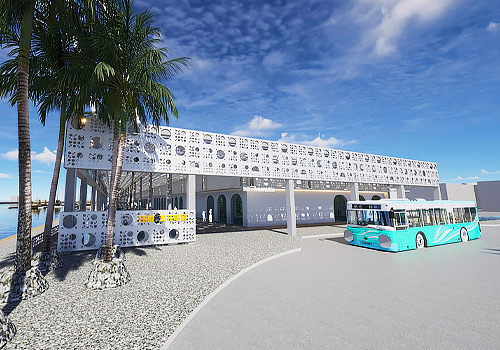
Entrant Company
CHANG CHIH CHENG Architect
Category
Conceptual Design - New Category: Waterfront & Harbor Renewal Architecture

Entrant Company
CO-DIRECTION INTERIOR DESIGN
Category
Interior Design - Showroom / Exhibit